Measuring Impact: Why the Journey, Not Just the Destination, Defines Sustainable Building
When assessing the environmental impact of a building, it’s not enough to look only at how much energy it consumes once it’s operational (the operational carbon). A growing focus in architecture and engineering is on embodied carbon—the greenhouse gas emissions associated with the materials and construction processes before the building is used.
Pre-Engineered Building (PEB) construction offers a compelling, low-carbon pathway that optimizes every stage of the building lifecycle, from material manufacturing to eventual deconstruction.
🏭 Stage 1: Manufacturing Control and Material Optimization
The low-carbon advantage of PEB begins right on the factory floor, a vast contrast to the uncontrolled environments of traditional sites.
- Precision Engineering: PEB components are designed using specialized software that calculates the minimum effective material required. This means there is no wasteful over-specification. Every beam, column, and purlin is optimized for the exact load it needs to carry, reducing the total amount of steel—and therefore the embodied carbon—used.
- Energy-Efficient Production: Manufacturing occurs in specialized facilities that can implement strict energy management systems. Unlike small, disparate construction teams, the factory can centralize waste recycling, optimize machine runtime, and control thermal processes, leading to lower energy consumption per unit of finished product.
- Recycled Steel Priority: As highlighted previously, many PEB manufacturers prioritize high-recycled-content steel, drastically lowering the embodied energy compared to materials requiring significant quantities of virgin ore.
🚚 Stage 2: Transportation and Logistics Efficiency
The way PEB components move from the factory to the site is a significant source of $\text{CO}_2$ savings compared to shipping multiple separate raw materials (e.g., gravel, cement, rebar, bulk timber).
- “Kit-of-Parts” Efficiency: The structural members are designed to nest tightly for maximum shipping density. This means fewer trucks are needed to deliver the entire structure.
- Reduced Weight: Because the design is highly optimized, the overall structural weight is lighter than a comparable conventionally built structure, further reducing the fuel required for transport.
- Fewer Deliveries: Everything arrives as a single, complete system package, cutting down on the numerous, fragmented deliveries typical of traditional construction, thereby reducing traffic congestion and associated emissions.
🏗️ Stage 3: Construction Site Impact
The construction phase itself is markedly cleaner, faster, and less disruptive with PEB.
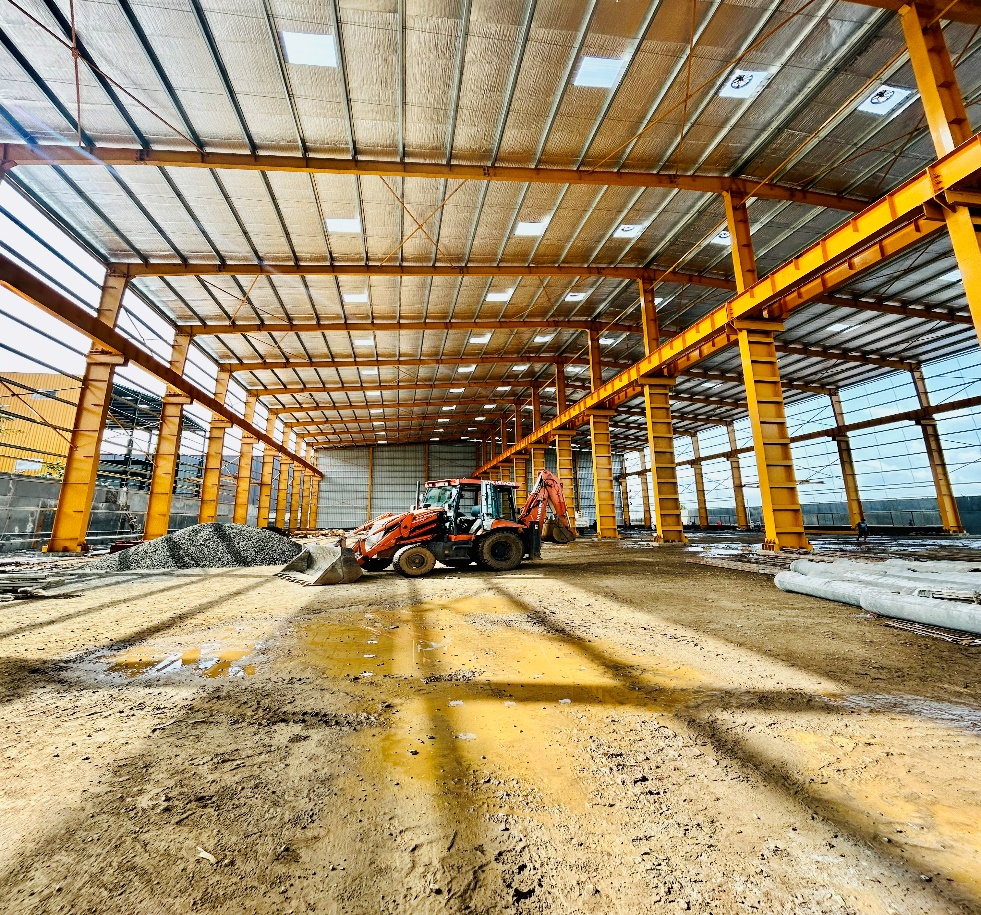
- Minimal Site Activity: The process is primarily assembly, not fabrication. This dramatically reduces the need for heavy, fuel-consuming site machinery (like welders, large compressors, and cutting equipment) for long periods.
- Reduced Waste Disposal: With near-zero material cutting on site, the energy and fuel required to haul away construction waste is practically eliminated.
- Faster Project Completion: Less time on site translates directly into less non-renewable energy consumption—be it electricity for lighting, fuel for temporary heating/cooling, or diesel for site generators.
🔄 Stage 4: End-of-Life and the Circular Economy
True sustainability requires a building to be considered a material bank, not a disposable asset. PEB excels at this final stage of the lifecycle.
- Design for Disassembly (DfD): Because PEB structures are bolted together, they are inherently designed for deconstruction, not demolition. This allows the structural components to be easily separated.
- Reuse Potential: The standardized, robust nature of steel members means they can often be inspected and re-used for another structure, bypassing the need for melting and recycling entirely—the ultimate form of resource efficiency.
- 100% Recyclability: If components cannot be reused, the steel is effortlessly recycled, completing the loop and contributing minimal landfill waste.
Lifecycle Assessment: The Future Standard
The low-carbon lifecycle of PEB construction positions it as a premier solution for sustainable development. By optimizing material input, minimizing transportation impact, reducing site energy consumption, and ensuring complete end-of-life recoverability, PEB offers a measurably superior environmental performance compared to traditional methods. Choosing PEB is choosing a comprehensive, responsible approach to building that honour both the present budget and the future planet.